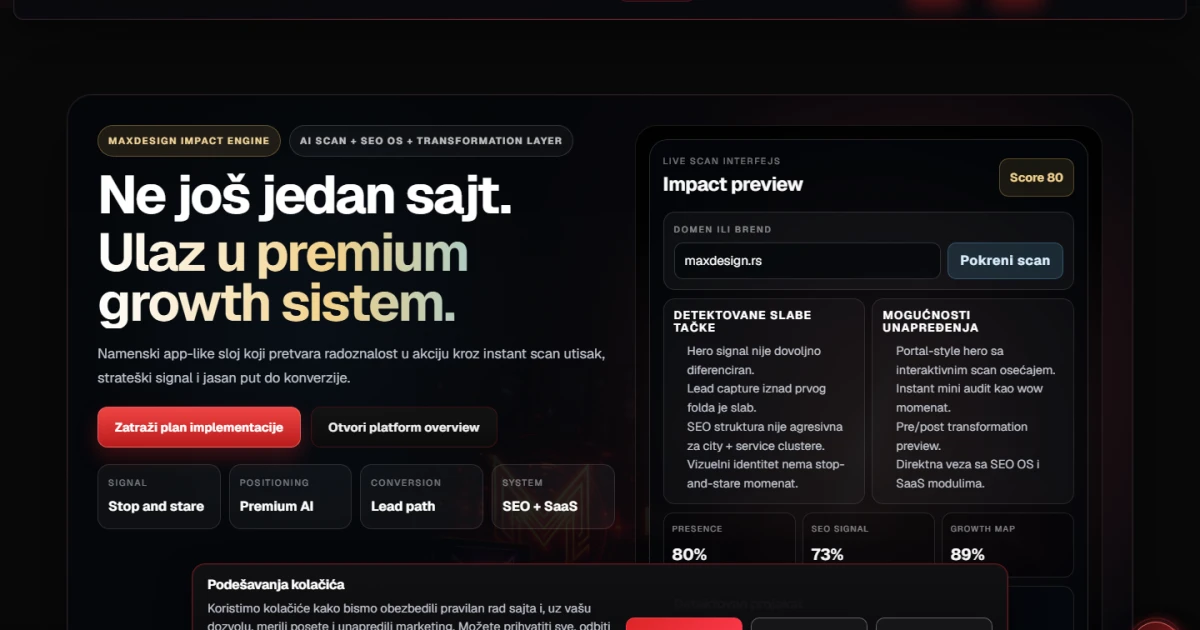
Most service business websites look professional and generate almost zero qualified inquiries. The problem is rarely aesthetics. It is architecture.
Here are five conversion design principles we apply to every client project. They cost nothing to implement and typically double inquiry rates within 60 days.
1. One Primary Action Per Page
Your homepage should not ask visitors to "Learn More," "View Portfolio," "Read Blog," and "Contact Us" with equal visual weight. Choose one primary action — usually "Book a Call" or "Request a Quote" — and make it visually dominant. Secondary actions should fade into the background.
2. Answer the Three Questions in 3 Seconds
Every visitor subconsciously asks:
- What do you do?
- Do you do it for someone like me?
- What should I do next?
If your hero section answers all three, you have passed the 3-second test. If not, the visitor bounces.
3. Proof Before Promise
Do not lead with "We are the best SEO agency in Belgrade." Lead with a specific outcome: "We increased organic traffic for a Belgrade law firm by 340% in 8 months." Specificity creates trust. Superlatives create skepticism.
4. Reduce Form Friction
Every field you add to a contact form reduces completion rates. For service firms, the minimum viable form is:
- Name
- Service type (dropdown)
- Message (optional)
Anything beyond that should be collected in a follow-up call, not the initial inquiry.
5. Progressive Disclosure
Do not dump your entire service catalog on the homepage. Start with the problem the visitor has. Offer a clear path to a solution. Reveal details as the visitor moves deeper: homepage → service page → case study → contact form.
Each step should feel like a natural continuation, not a pitch.
The 60-Day Test
Apply these five principles. Track inquiry volume and quality for 60 days. Most clients see a 40-120% increase in qualified leads without spending a cent on ads.
Bottom line: Conversion design is not about tricking visitors. It is about removing the friction between their intent and your offer.