One of the most common claims about AI is: “AI cannot replace experience.” That is true. But that claim often sounds as if AI is still just a toy, as if professionals who use it are doing something less valuable.
The real picture is different. AI does not replace experience, but it accelerates and multiplies it. A person with experience using AI as a system can do more than the same person without AI — without losing quality.
Experience is still essential
AI tools are incredibly capable. But they do not know:
- which business goal needs to be achieved,
- which compromise is acceptable,
- whether something will work in the real world,
- when to reject a generated solution,
- how to communicate with a client.
All of that comes from experience. AI can generate an answer, but an experienced person must judge whether that answer is good.
AI changes speed, not substance
Previously, a designer might spend days in Photoshop creating variations. Today, they can generate dozens of variations with AI tools in an hour, then select, refine, and test the best ones.
Previously, a developer might write a certain amount of code in a day. Today, the same developer with AI can write more code, but must carefully review, test, and refactor it.
Previously, an SEO expert manually analyzed keywords. Today, AI can process huge datasets, but the expert must interpret results and make decisions.
In every case, the substance of the work remains the same. Only the speed of execution changes.
Beginner with AI vs experienced with AI
A beginner with AI can create something that looks good. But without experience, they do not know:
- what to check,
- which errors are hidden,
- how the solution will behave in production,
- whether the solution is maintainable.
An experienced person with AI can create a serious system in the same time — because they know what is needed, what to reject, and how to connect pieces into a whole.
What this means for MaxDesign
MaxDesign combines human experience in web design, development, SEO, AEO, GEO, and content architecture with AI workflows. The goal is not to replace people. The goal is to build a system where experienced people with AI can deliver better results for clients.
Conclusion
The question is not “AI or experience.” The right question is: “What can an experienced person do when AI is used as a system, not a toy?” The answer is: much more, much faster, with the same or better quality.
Example: SEO expert with AI
Imagine an SEO expert who needs to analyze 5,000 keywords for a client. Without AI, this could take weeks. With AI tools, the expert can get clustering, intent suggestions, and competitor analysis in hours. But they must:
- check whether the clusters make sense,
- recognize local specifics that AI does not understand,
- reject suggestions that do not match the brand,
- interpret results in the context of the client’s goals.
Only then does analysis become decision-making. AI accelerated collection, but experience turned data into strategy.
How the developer role is changing
Developers will increasingly become architects and quality controllers. AI will write large amounts of code, but the developer must understand systems, security, scalability, and maintainability. The role shifts from writing every line to designing the overall solution.
How the designer role is changing
Designers will use AI to quickly explore styles and generate variants. However, creative decision-making, user understanding, and brand identity remain human tasks. A designer who understands AI can explore more options but still chooses the right one.
Building an AI workflow in a team
- Define where AI helps and where it does not.
- Set quality criteria for each phase.
- Introduce mandatory human review before publication.
- Record AI mistakes and adjust the process.
- Train the team to use AI as a tool, not a replacement.
What companies lose by ignoring AI
Companies that refuse to use AI will not disappear. But they will become slower and more expensive than competitors who effectively combine experience and automation. As AI use grows across all industries, ignoring the tool becomes a competitive disadvantage.
Closing thought
AI is a powerful multiplier, but not a substitute for experience. Companies that understand this will not only work faster — they will work smarter.
Building a learning culture
Teams that get the most from AI treat it as a skill to develop, not a button to press. They document what works, share prompts that produce good results, and review failures without blame. Over time, this culture compounds: junior members learn faster, senior members focus on higher-level decisions, and the whole organization becomes more productive. The real competitive advantage is not the tool itself, but the team’s ability to use it responsibly and well.
How experience affects AI output quality
Two people can use the same AI tool and get completely different results. The difference is experience. An experienced professional knows how to ask the right question, which variants to request, which errors to expect, and how to recognize a good answer. A beginner may get a seemingly good result that is actually problematic.
For example, AI can generate code that looks correct, but an experienced developer will immediately notice potential security issues, poor scalability, or inefficient database queries. AI can write text that sounds convincing, but an experienced copywriter will recognize that the tone is wrong for the brand or that a claim is inaccurate.
Example: AI in competitor analysis
An SEO expert can use AI to analyze the top 20 results for a keyword. AI will quickly extract common topics, content length, and heading types. But the experienced expert must interpret that data: which results rank because of brand authority versus content quality? Which topics are relevant to the client and which are coincidence? Which keywords are actually commercial versus informational?
Only after that interpretation does analysis become strategy. AI accelerated data collection, but experience turned data into a decision.
Building an AI workflow that preserves quality
The first step is to clearly define where AI helps and where it does not. The second step is to set quality criteria for each phase. The third step is to introduce mandatory human review before publication. The fourth step is to log AI mistakes and adjust prompts. The fifth step is to train the team to use AI as a tool, not a replacement.
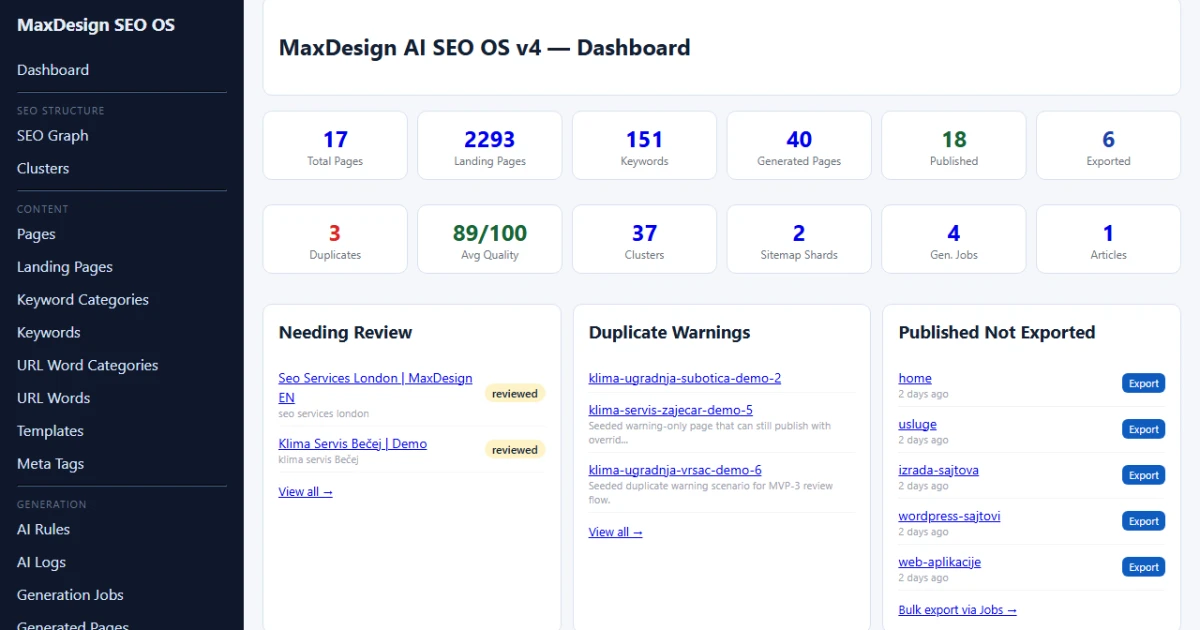
MaxDesign uses AI as part of its AI SEO system, but every project is led by an experienced team. For research on AI capabilities and limitations, see Anthropic Research and Google AI documentation.
Frequently asked questions
Does AI make human experience less important?
On the contrary. AI makes experience more important, because someone must know how to guide AI and what to accept or reject.
Will AI reduce the need for web developers?
Not entirely. But it will change how developers work. Those who use AI efficiently will have an advantage.
Is using AI tools in work cheating?
No. AI is a tool, like any other. What matters is how it is used and who uses it.
What is the best way for a team to start using AI productively?
Start with a clear process, quality criteria, and human control. AI without process creates chaos.
Does MaxDesign use AI in its everyday work?
Yes, as part of a systemic workflow. But every project is led by an experienced team.
Further reading
- Can AI Build a Professional Website? — related article.
- MaxDesign AI SEO system — how we combine experience and AI.
- Anthropic Research — research on AI capabilities and limitations.
- OpenAI documentation — additional authoritative source.
- Google AI documentation — additional authoritative source.
Want to learn how MaxDesign combines experience and AI?Schedule a call.