Just a few years ago, digital visibility meant one thing: being on the first page of Google. If you were among the top ten results for an important keyword, you got traffic. If not, you had to pay for ads.
That model still exists, but it is no longer the only one. Today, users increasingly ask ChatGPT, Gemini, Perplexity, or look at Google AI Overviews before clicking any link. The result: decisions about which brands enter consideration are made before visiting a website.
For businesses, this means that visibility is no longer just position. Visibility is now also mention in an AI answer, citation in a summary, recommendation in a conversation.
How the buyer journey has changed
Previously, the journey looked roughly like this:
- User types a query into Google.
- Scrolls through blue links.
- Clicks a few sites.
- Compares and decides.
Today the same journey may look like this:
- User asks an AI assistant for a recommendation.
- AI generates an answer with a list of brands and short explanations.
- The user may visit only one or two sites to confirm.
If your brand is not in that AI answer, you may never get the chance to fight for the click.
What this means for SEO strategy
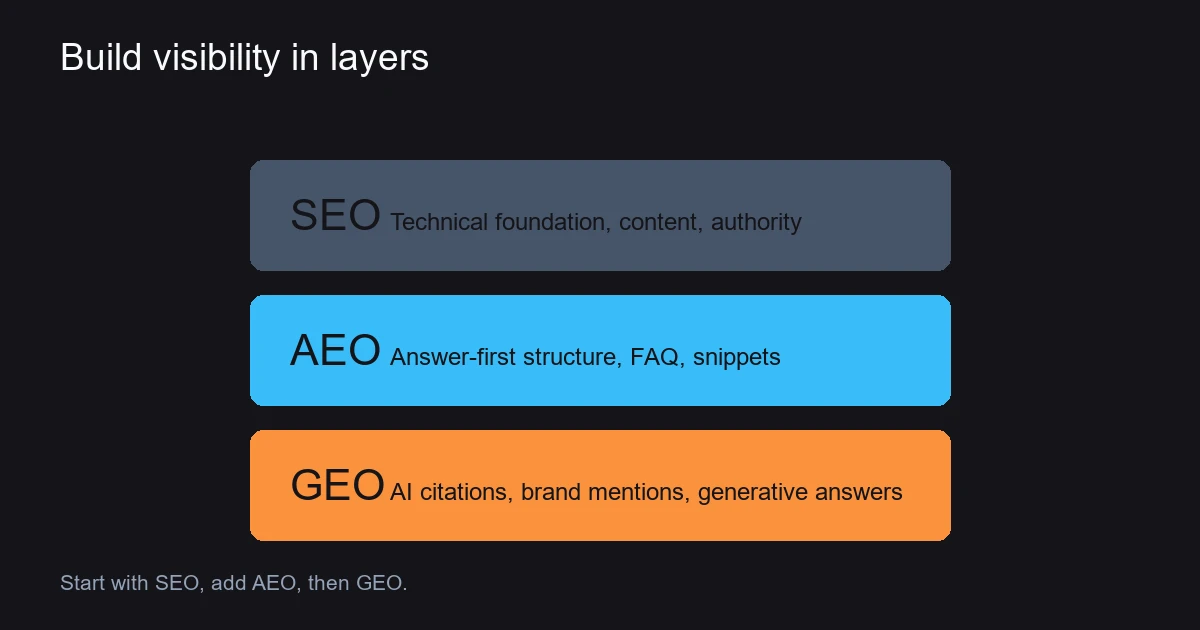
SEO is no longer just optimization for ranking. It has become optimization for understanding. To be recommended by AI, it must first understand you. This requires:
- Entity clarity. Clearly defined brand, services, people, locations.
- Structured answers. FAQ, definitions, comparisons, step-by-step content.
- Authority signals. External mentions, expert content, consistency.
- Quality technical foundation. Speed, accessibility, schema, mobile rendering.
This is what MaxDesign calls AI search visibility — brand readiness to be understood and recommended in AI surfaces.
Is classic SEO dying?
No. Classic SEO is still important. But its role is expanding. SEO used to be the goal. Now SEO is the foundation on which AEO, GEO, and AI recommendations are built.
Companies that refuse to adapt risk becoming invisible in the fastest-growing part of search. Companies that start building AI-ready structure early will have an advantage when AI recommendations become standard.
How to prepare
- Audit your current state. Where does your brand appear today? Where does it not?
- Simplify your message. Your site must clearly state who you are and what you do.
- Add structure. FAQ, schema, clear headings, internal links.
- Build authority. Publish useful content and be present in your industry.
- Monitor and iterate. AI models change. Regularly check how they describe you.
Conclusion
The shift from Google rankings to AI recommendations is not instant. It is happening gradually. That is precisely why it is important to start now. Companies that build clear, structured, authoritative presence early will have a significant advantage in the coming years.
How the value of a click is changing
In the past, every click had roughly the same value: a visitor arrived at your site and you had a chance to convince them. Today, before a user clicks, an AI assistant may form an opinion about brands. If you are not in that first answer, the click you might have earned earlier may no longer exist.
This does not mean SEO is worthless. It means SEO is now only one part of a broader visibility ecosystem. The value of clicks from traditional search remains, but it is amplified—or reduced—by the preceding AI answer.
Example: choosing a service provider
A company is looking for a website development agency. A few years ago, a marketer would type “website development Belgrade,” open five sites, and compare offers. Today, the same marketer might ask ChatGPT: “What are the best website development agencies in Belgrade and why?” If your agency is in the answer, you will likely be visited. If not, you may never enter consideration.
Signals AI systems recognize
- Entity clarity. AI must know who you are and what you do.
- Direct, useful answers. Pages that answer questions have an advantage.
- External authority. Mentions in relevant contexts strengthen reliability.
- Consistency over time. Information must be current and unified.
Building an AI-ready brand
- Audit your current AI visibility—where you appear and where you do not.
- Define a clear entity structure: brand, services, people, locations.
- Rewrite content in answer-first format with FAQ sections.
- Build authority through expert content and external mentions.
- Regularly check how AI models describe you and adjust strategy.
What is actually changing in search behavior
The shift is not happening overnight, but it is real. In Serbia, B2B buyers, IT professionals, and younger entrepreneurs increasingly use AI assistants for research. For services costing several thousand euros or more, buyers want recommendations before contacting sales. If your brand is not mentioned by AI, you may never enter the conversation.
This does not mean Google Search is disappearing. It means the value of a click is changing. A click from the top position on Google still matters, but it is amplified or reduced by the AI answer that came before it. A brand mentioned in the AI answer gets a higher-quality click. A brand not mentioned may lose clicks even if it ranks first.
Example: choosing a website agency
A marketer in Belgrade needs a new company website. A few years ago, they would type "website development Belgrade," open five sites, and compare offers. Today they might ask ChatGPT: "What are the best website development agencies in Belgrade and why?" If your agency is in the answer, you will likely be visited. If not, you may never be considered.
How small businesses can prepare
Small businesses have a speed advantage. In one week, you can update your homepage, add an FAQ section, and verify consistency across profiles. Large companies often need a month to align internal teams. Use that speed. Start with clear entity structure, then gradually add AEO and GEO layers.
For more on technical readiness, see Google Search Central — SEO starter guide and Google AI documentation.
Why waiting is risky
Waiting does not keep the status quo. It widens the gap between you and competitors who started earlier. AI models build associations from existing sources, and those associations become harder to change over time. A company that is unclear today may need a year of consistent work to fix perception later, while a competitor that started early will already own the topic.
Frequently asked questions
Will traditional Google Search stop existing?
No. Google Search will remain important, but its role will be shared with AI answers and recommendations.
Do AI recommendations matter for the Serbian market?
Yes. Although AI assistant usage in Serbia may be slower than in some countries, the trend is global and growing.
How long does it take for a company to build AI visibility?
It depends on the current state. Technical improvements are fast. Entity authority and AI citations require months to a year of consistent work.
Is having a technically good website enough on its own?
No. A good website is necessary but not sufficient. AI systems must understand and reliably cite your brand.
What is the biggest mistake companies make in the shift to AI recommendations?
The biggest mistake is waiting. AI recommendations will become standard, and companies that start late will have more catching up to do.
Further reading
- AI search visibility — what it means to be visible in AI search.
- MaxDesign AI SEO system — how we connect SEO, AEO, and GEO.
- Google — Generative AI in Search
- Google AI documentation — additional authoritative source.
- Anthropic Research — additional authoritative source.
Want your brand to be ready for AI recommendations?Request a strategic assessment.