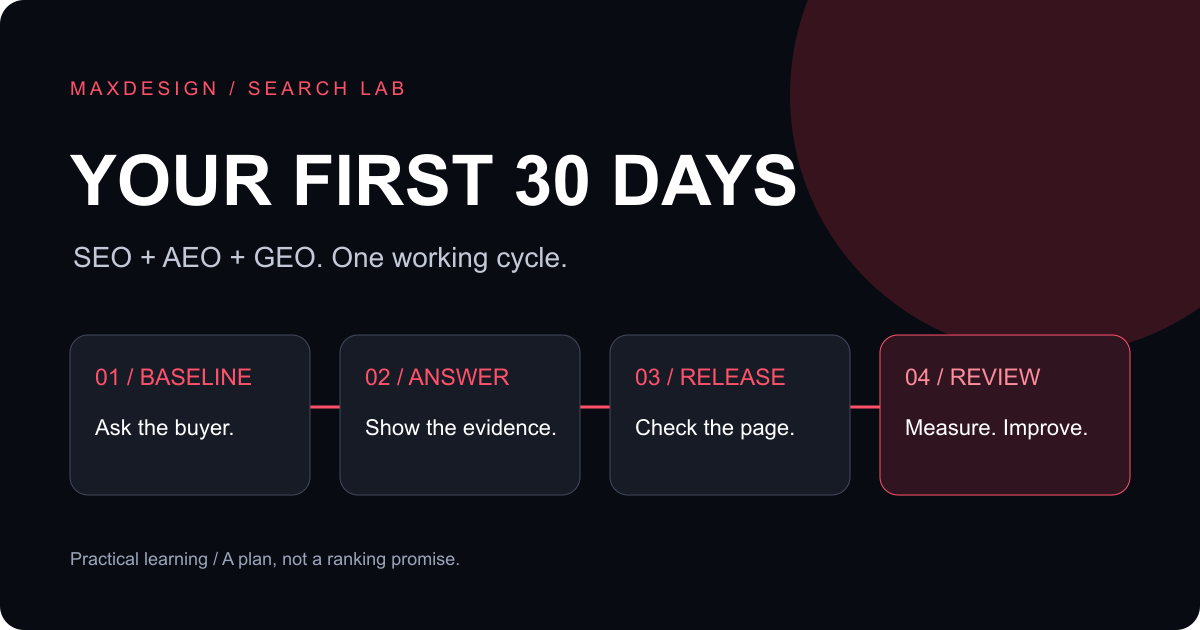
The first month should produce a documented baseline, an improved page and a repeatable review. Publishing ten interchangeable articles is not a prerequisite. Start with a buyer question and decide what evidence would justify the next change.
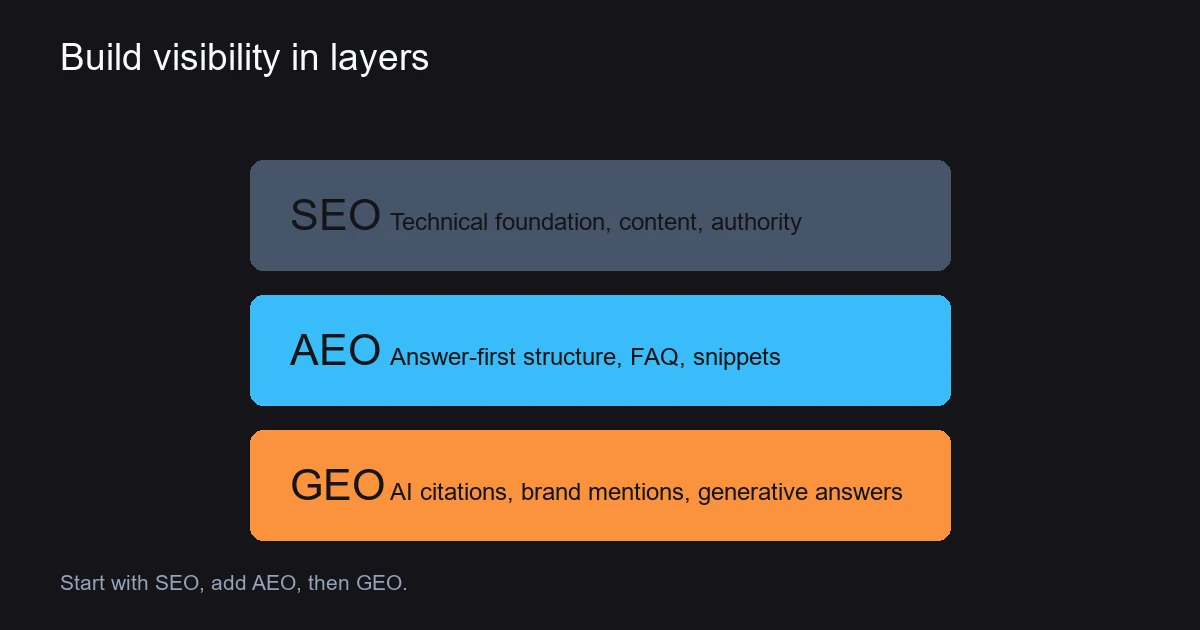
SEO supports discovery and understanding in search. AEO emphasizes clear answers. GEO addresses how a business is represented in generative responses. Their boundaries overlap; our SEO, AEO and GEO guide explains the terminology. This plan turns it into a working cycle.
Week one: choose an offer and establish the baseline
Select a service you actually want to sell. List five questions buyers ask before committing: deliverables, suitability, price drivers, preparation and handover. Use real sales conversations where available, but remove confidential client details.
For one existing page, save a completed Search Console reporting window and its filters. Check the HTTP response, title, description, main heading and intended indexability. Test the contact route as well. An inaccessible page or broken form takes priority over decorative additions.
Week two: write an answer a buyer can verify
Consider “What do I receive after an SEO audit?” Replace “a revolutionary analysis” with a precise deliverable: affected URLs, evidence, impact, priority and recommended action. If implementation is a separate service, say so. Clear scope helps a buyer evaluate the work.
Illustrative finding: “Three pages have no description. That does not prove they cannot be indexed. We propose distinct descriptions that reflect each page, followed by a review of clicks and impressions for comparable queries.”
Include an approved project example or an explicitly illustrative example. Avoid invented results. Connect the educational page to a relevant service, and the service to the deeper explanation. The content should answer a practical question even if the visitor never becomes a lead.
Week three: verify the published experience
- Read the introduction on a phone without zooming.
- Open internal links and test invalid as well as valid form input.
- Check the canonical, indexability and appropriate sitemap inclusion.
- Check translated pages and their reciprocal language links.
- Verify analytics under the relevant consent choice.
Google's AI features guidance points to existing SEO fundamentals. Prioritize accessible, useful information rather than treating a special AI markup claim as the entire strategy.
Week four: repeat the checks and record uncertainty
For AI answers, record neutral prompts, system, date, language, location and cited sources. A mention, a linked citation and an enquiry are different outcomes. Incognito mode and a VPN do not turn a single answer into a universal ranking. Use our AI visibility measurement guide for a more detailed protocol.
Thirty days is a work schedule, not a ranking promise. If the sample is too small, continue observing. If impressions grow without clicks, use the position and CTR diagnostic. If clicks grow without enquiries, inspect the offer and conversion path.
A worksheet for European and global teams
- Buyer question and target URL.
- Country, language and intended audience.
- Baseline date, reporting filters and evidence.
- Specific change and expected effect.
- Owner, reviewer and release date.
- Result classified as observed, hypothetical or insufficient data.
For European expansion, review countries separately even where they share a language. Translate meaning and buyer context, not merely keywords. Google documents how to identify localized versions; that technical annotation does not replace local research.
Start with the MXD technical readiness and AI visibility check, then repeat the cycle for your highest-value pages. For a wider market plan, continue with our European multilingual guide.