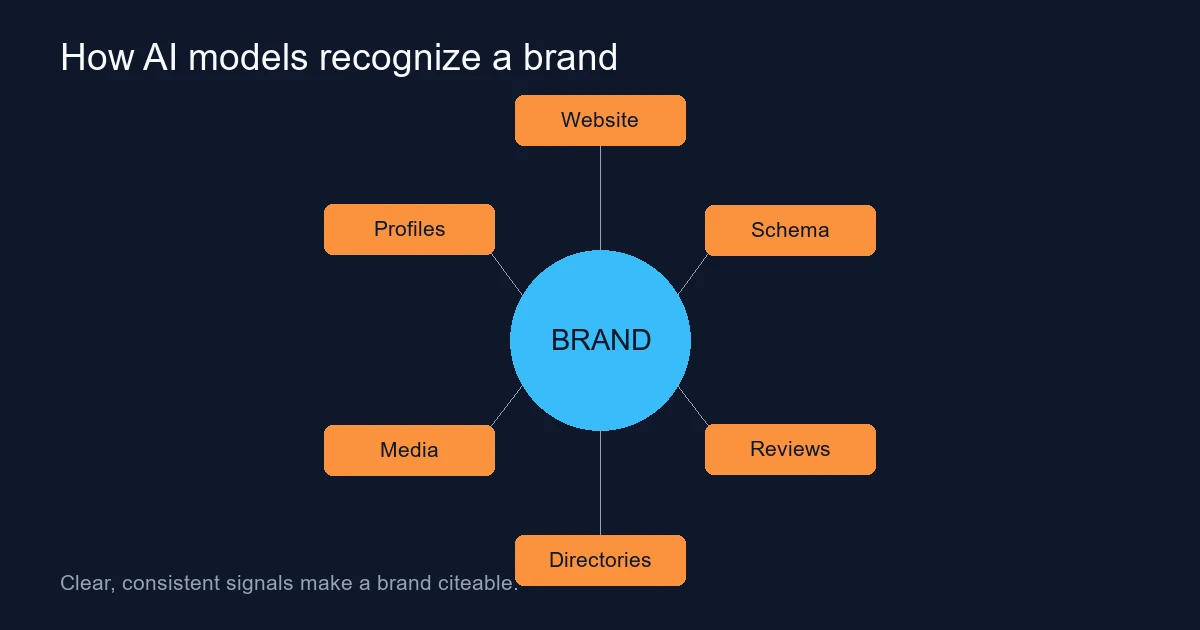
When someone asks ChatGPT, Gemini, or Perplexity for a recommendation, these tools do not “Google” in real time the way a human does. They use a large language model trained on a massive corpus of text, connected to search systems that can reach fresher sources. The result is a generated answer in which some brands are mentioned and others are not.
The question that is becoming increasingly important for businesses is: why are some brands mentioned and others not?
The answer is not about which brand wrote its name most often on its website. The key is how AI systems assess reliability, relevance, and entity clarity.
Three factors that influence AI citation
1. Entity clarity
AI models need to know who you are. This means your brand must be a clear entity: name, location, services, people, website. If you are “some company that does something with websites,” AI will skip you. If you are a clearly defined company with a concrete offering, you are more likely to be recognized.
This is the core of entity SEO — the discipline that helps search engines and AI models understand who you are and what you do.
2. Access to structured, citation-ready information
AI systems like clear, direct answers. A page that starts with “Our agency offers complete digital solutions” is hard to cite. A page that says “MaxDesign is a web and SEO studio in Belgrade that builds custom Laravel systems, AI-ready websites, and SEO/AEO/GEO architecture” gives AI models concrete material.
That is why the following matter:
- clear service descriptions,
- FAQ sections with concrete questions and answers,
- schema markup that connects entities,
- and consistent terminology.
3. Authoritative external signals
AI models do not look only at your website. They also train on text from other sites — media, directories, social networks, publications. If your brand is regularly mentioned in relevant contexts, AI will consider it more reliable.
This does not mean buying links. It means being present where your industry is naturally discussed: LinkedIn posts, guest articles, directories, podcasts, expert comments.
How ChatGPT, Gemini, and Perplexity differ
ChatGPT often answers based on training knowledge, with optional search if enabled. It prefers clear, well-formatted sources it saw frequently during training.
Gemini has a stronger tie to the Google ecosystem. This makes Google Business Profile, Knowledge Graph, schema markup, and Google AI Overviews optimization important.
Perplexity directly cites sources. It favors authoritative pages that give direct, well-supported answers.
For a business, this means you should not optimize for one tool. You should build AI search visibility as a system.
What you can do today
- Define your brand clearly. Write one sentence that explains who you are, what you do, and for whom.
- Add FAQ to service pages. Use real client questions.
- Implement schema markup. Start with Organization, WebSite, Service, and FAQPage.
- Be consistent everywhere. Same name, address, services across all profiles.
- Publish helpful content. Blog posts, guides, explanations — anything that shows expertise.
Conclusion
AI models do not choose brands because they are “the best.” They choose brands they can clearly understand and reliably cite. That is good news for small and medium businesses — because this can be worked on systematically, without a huge budget.
A practical view of the citation pipeline
When a user asks “Recommend a good SEO agency in Belgrade,” the AI does not open a browser and click links. It combines training knowledge, possible real-time search, and structured data in milliseconds. We can roughly divide the process into four steps:
Understanding the query
The model first understands the location (Belgrade), intent (recommendation), and category (SEO agency). If your brand is not clearly linked to these entities, you will not be considered.
Retrieving sources
The tool searches its memory and, if it has web access, relevant pages. It prefers sources that directly answer the question rather than pages offering “complete solutions” without detail.
Ranking candidates
The model forms a list of brands that meet the criteria. This is where entity clarity and direct answers on your site matter: the AI needs enough reliable data to mention your brand confidently.
Verifying accuracy
Before finalizing the answer, the model checks whether the data is consistent. If contradictory information exists about your business, it will likely skip you.
Signals that weaken a brand
- Inconsistent company name. Different name variants across the website, social profiles, and directories confuse AI models.
- Overly generic descriptions. “We offer complete solutions” gives the model nothing to cite.
- Missing schema markup. Without Organization, Service, and FAQPage schema, AI must infer from text.
- Outdated data. If AI finds stale information, it may pass it on or skip your brand.
Why some local brands appear in AI answers first
In smaller markets like Serbia, AI models have fewer high-quality sources to choose from. This creates an opportunity for local brands that organize their information well. A Belgrade web agency with a clear website, active LinkedIn presence, consistent Google Business Profile, and specialized blog content can become a reference point faster than a generic global competitor.
The key is to make the brand easy to understand. If a model can extract a clear sentence about who you are, what you do, and where you operate, you are more likely to be mentioned. If the model has to piece together fragmented information, it will likely skip you.
Example: a B2B software company
Imagine a company selling project management software to Serbian construction firms. A query like "What software do Serbian construction companies use for project management?" requires the model to connect several entities: construction, Serbia, project management software, and specific brand names. If the company has a page titled "Project Management Software for Construction Companies in Serbia" with clear descriptions and schema markup, it has a much better chance of being cited.
How to monitor your AI citation progress
Track the same set of questions monthly across ChatGPT, Gemini, and Perplexity. Record whether your brand appears, in what context, and which competitors are mentioned. Also track whether the information is accurate. If AI cites outdated services, update the source pages. This simple monitoring habit gives you a clear picture of progress.
Refer to schema.org and Google Search Central — Structured data for implementation guidance.
Frequently asked questions
Do AI models use only websites when selecting sources?
No. They use text from a wide range of sources, including websites, publications, directories, social media, and academic sources. It is important that brand data is consistent everywhere.
Can anyone guarantee that a brand will be mentioned in an AI answer?
No. No one can guarantee a citation in an AI answer. But you can significantly improve your chances through clear entities, structured content, and authoritative signals.
For AI citations, is content quantity or quality more important?
Quality and clarity matter more. Hundreds of generic pages can hurt more than help. It is better to have fewer but well-structured pages.
How often do AI models update their knowledge about brands?
It depends on the model and platform. Some update frequently, others have longer cycles. That is why it is important to maintain clear and accurate brand information continuously.
What is the best first step toward better AI brand citations?
The best first step is an audit of the current state: how AI models today describe your brand. That gives you a baseline to work from.
Further reading
- ChatGPT visibility agency Serbia — service page on increasing ChatGPT visibility.
- Entity SEO — how to build clear entities.
- schema.org — official structured data documentation.
- Google Search Central — Structured data — additional authoritative source.
- OpenAI Research — additional authoritative source.
Want to know how AI models currently see your brand?Request an AI visibility assessment.


